Go Testbed Expected Results
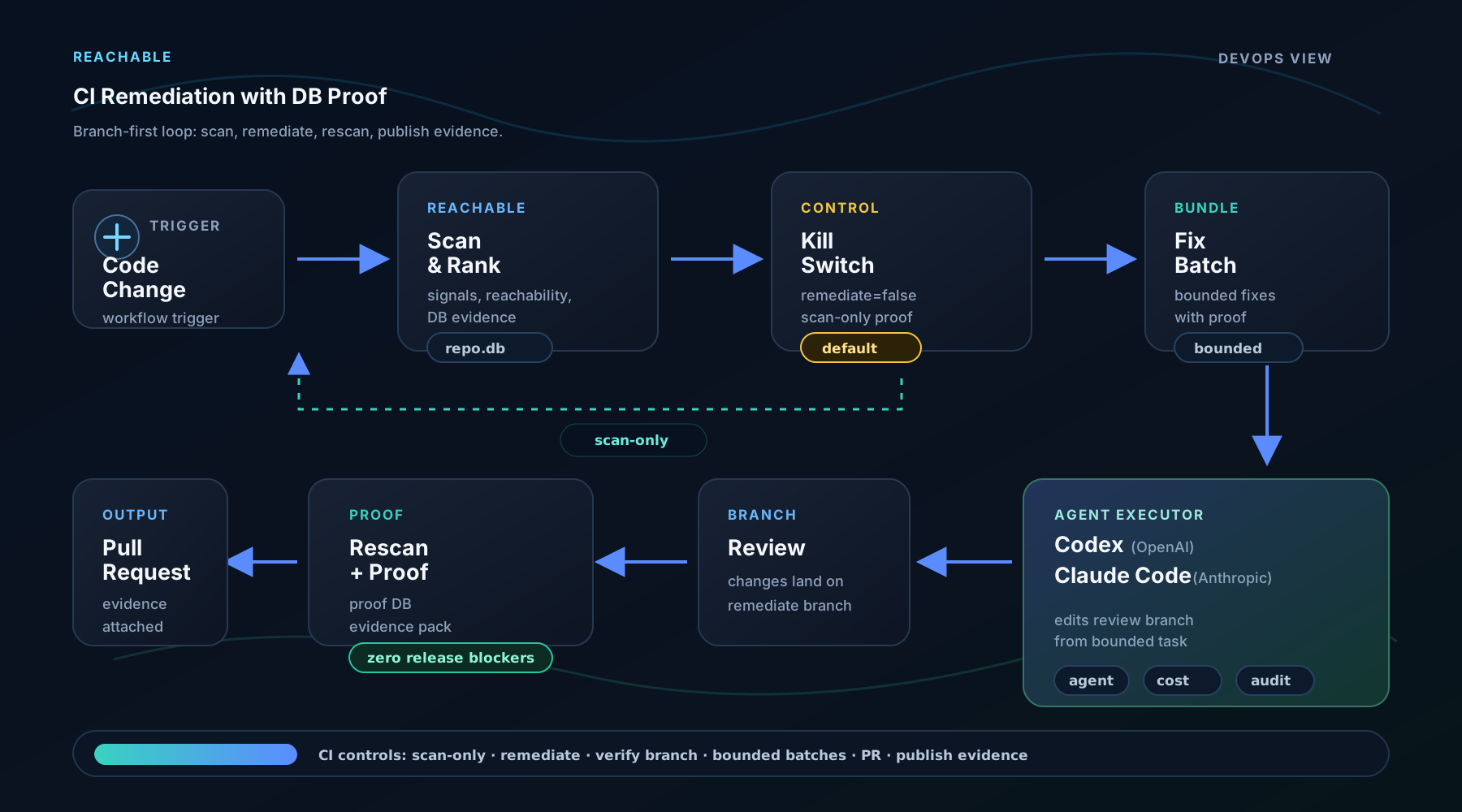
A compact demo for CI scanning and agent-driven remediation. It proves that Reachable can identify the release-blocking queue from database evidence, generate a bounded remediation task, let an agent patch a review branch, and rescan that branch to zero release blockers. Workflow security is represented here only by a compact customer-facing subset, not the full support corpus or remediation experiment matrix.
Evidence Links
This page explains the demo contract. The current run status, source code, workflow definition, expected contract, and published proof artifacts are linked here so the evidence can be traced.
Expected raw scanner truth on main.
Release-blocking queue before remediation.
DB evidence rows used in the public proof.
Release blockers after remediation.
What Had To Be Fixed
This is the release decision view. These are the baseline problems that must disappear from the remediation proof scan before the branch is safe to review and merge.
| Release category | Rows before | Expected proof | Remediated? | Meaning |
|---|---|---|---|---|
| Exploitable blockers | 3 | 0 | Yes | Enzo attacker proved external control and impact. These are mandatory fixes. |
| Not-attacked / exposure blockers | 9 | 0 | Yes | No attacker proof is required for reachable CVEs, embedded secrets, PII/DLP exposure, or AI-boundary authority risk. They still block release while present. |
| Defended attacker evidence | 9 | 0 blockers | No, unless a fix naturally removes them | Reachable found the path, but Enzo attacker could not prove a practical attack. These rows are audit evidence, not release blockers. |
| Filtered fixture evidence | 7 | Nonblocking | No | Synthetic not-reachable or non-production markers prove scanner coverage and are not part of the fix queue. |
| Workflow-security guidance | 25 | Nonblocking admin guidance | No autonomous code fix | The demo keeps a compact CI/CD workflow-authority subset visible for review without turning this repo into the workflow-security lab. |
| Total raw DB signals | 53 | 0 release blockers | 12 remediated blockers | The proof scan passes when the release-blocking queue is zero. |
| Fix category | Rows | Exploitability | Why it blocks release | Expected proof after remediation |
|---|---|---|---|---|
| Application attack paths | 9 | Exploitable | Enzo attacker evidence says reachable CWE/AI paths are attackable, including command execution, SSRF/fetch, and externally visible error disclosure. | Those rows are absent from the proof scan. |
| Dependency risk | 1 | Reachable, not attack-proofed | A reachable Go dependency has a fix-available vulnerability. | The fixed dependency version is used and the CVE row is absent. |
| Secret exposure | 1 | Exposure | A synthetic production-shaped token is embedded in application code. | The token row is absent; fixture-only markers remain non-actionable. |
| DLP / PII exposure | 2 | Exposure | Synthetic personal data is logged or sent to an outbound endpoint. | Raw personal data exposure rows are absent. |
| AI boundary and tool-risk rows | 5 | Exploitable / exposure / authority risk | LLM calls, sensitive context, tool instructions, and unguarded user flows cross AI trust boundaries. | The AI rows are absent or covered by the underlying code fix. |
| Total release blockers | 12 | Actionable | Baseline queue that must be fixed before release. | 0 release blockers after remediation. |
Defendable And Nonblocking Evidence
These rows are still part of the baseline evidence, but they are not the final release-blocking queue. They explain why the raw database has more signals than the fix queue.
| Evidence category | Rows | Meaning |
|---|---|---|
| Defended attacker rows | 9 | Reachable paths reviewed by Enzo attacker and classified as defended, not exploitable. |
| Non-production or not-reachable fixture markers | 7 | Synthetic detector coverage rows such as workflow variable names and fixture markers. |
| Workflow-security guidance subset | 25 | A compact CI/CD authority-review subset kept in the public demo contract, without importing the larger support corpus. |
| Total nonblocking evidence | 41 | Tracked for auditability, not counted as release blockers. |
Why Defended Rows Do Not Block Release
Reachable keeps defended rows in the evidence when it finds a security-shaped sink, but Enzo attacker cannot prove an external attacker can drive that sink to impact. That gives the release owner an audit trail without forcing a non-exploitable item into the fix queue.
| Defended row | Why it was found | What blocks the attack |
|---|---|---|
CWE/200internal/handlers/cve.go:16 | The handler returns an internal request-body read error string. | The body is read through io.LimitReader, so the request body is bounded; this path is an I/O failure path, not attacker-controlled parser content. |
CWE/200internal/handlers/cve.go:38 | language.Parse can produce detailed parsing errors. | The route first calls safety.AllowedLanguageTag, which allows only en, en-US, fr, fr-FR, es, and es-ES. Attacker-chosen language tags do not reach the parser. |
CWE/200internal/handlers/suspicious.go:24 | The tool-fetch route returns an os.Create error. | The local file path is fixed with filepath.Join(os.TempDir(), "reach-testbed-tool.bin"). The caller controls the source URL, not the local file path that could shape this error. |
Baseline Signal Breakdown
| Family | Expected signals | Release blockers | Exploitability dimension | Nonblocking evidence | Expected proof |
|---|---|---|---|---|---|
| CVE | 1 | 1 | Reachable, not attack-proofed | 0 | Fixed dependency version; CVE row absent from proof scan. |
| CWE | 15 | 3 | 3 exploitable, 9 defended, 3 filtered | 12 nonblocking rows | Command execution, SSRF/network fetch, and blocking error-disclosure rows absent from proof scan. |
| Secret | 3 | 1 | Exposure | 2 filtered rows | Synthetic production token absent; workflow-template noise is not part of the baseline anymore. |
| DLP | 2 | 2 | Exposure | 0 | Synthetic personal data exposure rows absent. |
| AI | 7 | 5 | Reachable authority/exposure plus unguarded flow | 2 nonblocking rows | AI-boundary and unguarded-flow rows absent or covered by underlying code fixes. |
| Workflow Security | 25 | 0 | Workflow authority review | 25 guidance rows | Retained as a compact customer-demo workflow-security subset; not part of the autonomous code-remediation queue. |
| Total | 53 | 12 | 3 exploitable rows plus exposure/reachable blockers | 41 | 0 release blockers after remediation. |
Expected Findings
The table separates the dimensions a release owner needs to understand: raw DB signal count, risk, reachability, and exploitability. A row with more than one DB signal is an explicit group, not a hidden assumption.
| ID | DB signals | Type | Risk | Reachability | Exploitability | Location | Explanation | Remediation |
|---|---|---|---|---|---|---|---|---|
| GO-CVE-01 | 1 | CVE-2022-32149 / golang.org/x/text | High | Reachable | Not attack-proofed | internal/handlers/cve.go; go.mod | A public language parsing route exercises an old dependency with a denial-of-service advisory. | Upgrade golang.org/x/text to a fixed version and keep route-level input validation. |
| GO-CWE-01 Deferred | 1 | CWE / command injection | Critical | Reachable | Exploitable | internal/handlers/cwe.go | A request parameter is concatenated into a shell command. A caller could turn a diagnostic endpoint into command execution. This case remains in the vulnerable baseline contract, but is temporarily deferred from the autonomous-remediation proof because the current agent loop leaves DiagnosticPing unchanged when SafeDiagnosticPing already exists. | Manual-review/deferred for this demo. The reach-core follow-up is to tighten the remediation prompt so the agent modifies DiagnosticPing itself. |
| GO-CWE-02 | 1 | CWE / user-controlled URL fetch | Critical | Reachable | Exploitable | internal/handlers/suspicious.go | An admin route downloads from a caller-supplied URL. This models unsafe tool staging and SSRF-style fetch behavior. | Restrict sources to a trusted allowlist, require authentication, verify checksums/signatures, and avoid arbitrary outbound fetches. |
| GO-CWE-03 | 1 | CWE / SSRF HTTP client | Medium | Reachable | Exploitable | internal/handlers/suspicious.go | User input reaches an HTTP client, so server-side infrastructure could be asked to call untrusted destinations. | Use URL validation, deny private/internal ranges, enforce trusted schemes/hosts, and add timeouts. |
| GO-CWE-04 | 3 | CWE / error disclosure | Medium | Mixed blocking/nonblocking | Mixed exploitable/defended | internal/handlers/cve.go | Parser errors are returned directly to clients, potentially exposing implementation details; non-attacker-controlled instances are retained as nonblocking evidence. | Return generic client errors and log details internally. |
| GO-CWE-05 | 3 | CWE / error disclosure | Medium | Reachable | Exploitable | internal/handlers/ai.go | JSON decoding errors are returned directly from AI endpoints. | Return generic bad-request text and preserve details only in structured logs. |
| GO-CWE-06 | 3 | CWE / error disclosure | Medium | Mixed blocking/nonblocking | Mixed exploitable/defended | internal/handlers/suspicious.go | Network, file, and copy errors from the tool-fetch path are exposed to callers; one internal-only instance is retained as nonblocking evidence. | Return generic operational errors; keep internal details in logs or audit events. |
| GO-SECRET-01 | 1 | Secret / GitHub token shape | Medium | Reachable | Exposure | internal/handlers/secrets.go | A synthetic GitHub-shaped token is embedded in code and returned by an API. In a real system this would be a credential leak. | Rotate the value, remove it from code, load it from a secret manager, and never return it in responses. |
| GO-SECRET-02 | 1 | Secret / AWS access key shape | Info | Not reachable | Not applicable | internal/handlers/secrets.go | An AWS-shaped synthetic marker is present for detector coverage but is filtered as non-actionable in the latest proof. | Keep only synthetic test markers in fixtures; never put real cloud credentials in source. |
| GO-SECRET-03 | 1 | Secret / static token detector overlap | Info | Not reachable | Not applicable | internal/handlers/secrets.go | A generic token-shape detector overlaps the synthetic GitHub PAT fixture on the same line. The specific GitHub PAT row is the one that remains actionable. | No separate code fix required. This overlap remains audit evidence only. |
| GO-DLP-01 | 1 | DLP / PII to log | Critical | Reachable | Exposure | internal/handlers/dlp.go | Synthetic SSN and date-of-birth values are written to logs. In production this would create regulated-data exposure. | Mask sensitive values, minimize logging, and add structured audit logging without raw identifiers. |
| GO-DLP-02 | 1 | DLP / PII to outbound HTTP | Critical | Reachable | Exposure | internal/handlers/dlp.go | Synthetic personal data is sent to an external analytics endpoint. | Remove raw PII from outbound telemetry, tokenize fields, and enforce data-sharing controls. |
| GO-AI-01 | 1 | AI / LLM API call with sensitive context | Critical | Reachable | Exposure | internal/handlers/ai.go | User-controlled prompt content is sent to an LLM call in an admin-style context. | Separate system and user messages, treat user content as data, and apply policy checks before model calls. |
| GO-AI-02 | 1 | AI / agent tool instruction risk | Critical | Reachable | Reachable authority risk | internal/handlers/ai.go | User input is mixed into an internal automation-agent tool specification. | Use constrained tool schemas, allowlisted actions, explicit authorization, and policy checks. |
| GO-AI-03 | 1 | AI / unguarded flow to command execution | Medium | Reachable | Exploitable | internal/handlers/cwe.go | Reachable taint flow confirms the command-injection path has user-controlled input. | Fixed by the command-injection remediation. |
| GO-AI-04 | 1 | AI / unguarded flow to error/output response | Medium | Reachable | Exploitable | internal/handlers/cwe.go | User-controlled diagnostic behavior can influence returned output. | Fixed by removing shell execution and normalizing errors. |
| GO-AI-05 | 1 | AI / unguarded flow to network fetch | Medium | Reachable | Exploitable | internal/handlers/suspicious.go | User input controls the outbound fetch destination. | Fixed by the URL allowlist and SSRF controls. |
| GO-WORKFLOW-01 | 25 | Workflow Security / CI/CD authority paths | Mixed | Reachable workflow authority | Admin guidance | .github/workflows/reachable-workflow-security-fixture.yml | The compact workflow-security fixture proves command injection, code injection, broken authorization, cross-workflow privilege escalation, untrusted checkout, OIDC/secret authority exposure, action pinning drift, and artifact-poisoning companion findings. Workflow files are owned by the dedicated workflow_security lane rather than the generic secret lane. | Review workflow trust boundaries, protect low-trust triggers, pin actions, narrow secrets/OIDC scope, and keep privileged sinks behind manual or protected release boundaries. |
| Total | 53 | Raw DB signals represented by the grouped expected-finding contract. | ||||||
CI Flow Overview
The flow below is supporting context. The verdict itself comes from the scan database and the expected-finding contract above.
Workflow Details
This page is the contract and evidence view. The CI mechanics, inputs, guardrails, and repository layout live in the repository README and the Reachable Remediation Template workflow.